

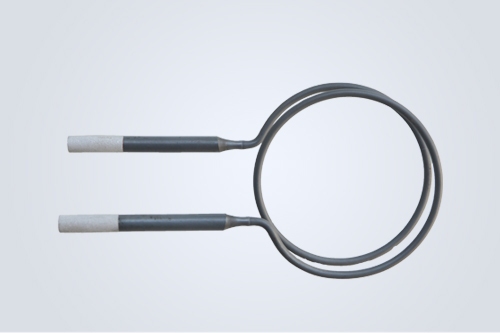
High-temperature industrial processes, from semiconductor manufacturing to advanced ceramic sintering, require steady thermal performance. The molybdenum disilicide heating element sits at the core of these systems. It can reach surface temperatures up to 1800°C in oxidizing atmospheres. Yet the reliability of any MoSi2 heater rests on the strength of its protective quartz (SiO₂) layer. When this layer fails, or mechanical stresses build up, system efficiency falls, and costly downtime follows. Knowing the exact failure mechanisms and the right corrective steps helps maintain steady operation in demanding B2B settings.
Locating the exact cause of the malfunction is step one. Since the molybdenum disilicide heat resistance element behaves similarly to ceramics, it exhibits good hardness (570 kg/mm²) but is brittle when exposed to room temperature conditions. The failure occurs due to chemical attack, thermal stress, or physical abuse.
One of the most surprising failures happens not at peak temperature but between 400°C and 700°C. In this range, the MoSi2 heater body can suffer “pesting.” The material turns to powder. The dense, protective SiO₂ film only forms well above 1000°C. Without it, oxygen moves into the grain boundaries, rapid volume growth occurs, and the structure breaks apart.
Bubbles or peeling on the surface of a MoSi2 heating element point to a break in the quartz film. Songshan has identified several technical triggers for this issue.
*Iron Impurities: Residual iron (Fe₂O₃) left from raw materials or binders stops a dense SiO₂ layer from forming. Localized bubbling results.
*Welding Defects: Incomplete welds between the hot zone and cold end let the glass phase overflow. Voids appear and later fail under electrical load.
*Atmospheric Attack: Repeated thermal cycling or contact with corrosive gases can strip the protective glaze. The inner MoSi2 then faces rapid oxidation.
Mechanical failure often occurs during installation or cooling. The molybdenum disilicide heating element stays brittle at normal temperatures. Any rigid mount that blocks thermal expansion can create cracks. If an element is not hung vertically, it may sag or snap once it reaches a plastic state above 1200°C.
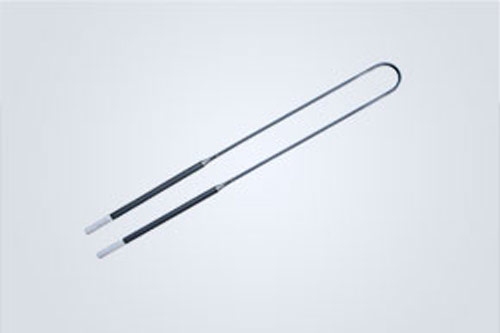
After the failure point is found, targeted restoration or maintenance steps can often save the system and avoid repeat problems. Songshan supplies technical frameworks that help these components reach their full service life of 3000 to 5000 hours.
If a MoSi2 heating element shows surface depletion but remains structurally sound, the protective film can often be restored through a process called “re-glazing.”
*Clean the Atmosphere: Make sure the furnace contains no reducing gases or contaminants.
*Controlled Oxidation: Run the heater above 1200°C in an oxidizing environment.
*Film Formation: At these temperatures, the molybdenum disilicide heating element reacts with oxygen and rebuilds a continuous, non-porous quartz glass film. This film blocks oxygen and stops further internal corrosion.
Fixing mechanical issues means switching to the vertically hanging method.
*Element Holders: Use special holders that support the full weight of the moly disilicide heating elements from the furnace top.
*Flexibility in Wiring: Connection straps made of aluminum braid must have enough slack. This prevents mechanical stress from reaching the brittle element when the furnace structure expands and contracts.
*Centering: Make sure the through-brick holes are 1.5 times the diameter of the cold end. Free movement then becomes possible.
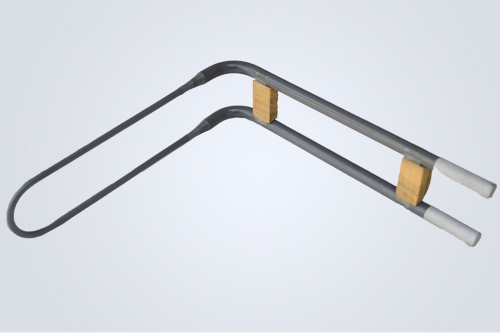
In cases of total fracture or severe “pesting,” replacement is the only practical option. Unlike silicon carbide elements, which age and increase in resistance, the MoSi2 heater keeps stable resistance over time. This unique property allows old and new elements to work together without upsetting the circuit.
When one molybdenum disilicide heating element fails in a multi-element furnace, follow these steps.
*Disconnect the aluminum braid straps and remove the lead wire clamps.
*Clear any ceramic cotton or insulation packing from the insertion hole.
*Carefully pull the damaged through-brick and element out through the furnace roof.
*Insert the new molybdenum disilicide heating element. Make sure the tapered part of the cold end enters the furnace chamber so localized overheating does not occur.
*Repack the gap with high-purity ceramic fiber and reconnect the electrical leads.
It is important to replace the failed unit with the correct material grade. Songshan offers two primary grades.
*MS17 (1700°C): Suitable for most industrial heat treatment and forging applications.
*MS18 (1800°C): Designed for laboratory furnaces and high-temperature sintering that require extreme thermal precision. Using an MS17 element in a system built for MS18 temperatures will cause immediate failure. The SiO₂ film reaches its fusion point at 1710°C.
Keeping a high-temperature furnace running well requires a clear understanding of the molybdenum disilicide heating element and its chemical relationship with the surrounding environment. Monitoring the SiO₂ protective film, avoiding the 400–700°C pesting range, and using flexible vertical installation all help extend service life. Because the resistance of the MoSi2 heater stays stable, maintenance stays straightforward. Old and new parts can be swapped without complex circuit recalibration.
For expert technical support and high-purity replacement parts, please contact us at Songshan.
A: The most effective way to prevent breakage is to hang the element vertically and avoid mechanical stress. The MoSi2 heater is very brittle at room temperature. All connection straps should be flexible aluminum braids with enough slack to accommodate thermal expansion.
A: Yes. New and old molybdenum disilicide heating element units can be used together. Unlike silicon carbide elements, the electrical resistance of MoSi2 does not change much with age. The load stays balanced even when elements of different service ages are mixed.
A: Bubbling often comes from impurities such as iron in the raw material or from welding defects at the junction of the hot and cold ends. These defects stop the dense SiO₂ protective film from forming. Gases escape from the matrix and form bubbles that eventually lead to localized failure.
© Henan Zhengzhou Songshan Enterprise Group Co., Ltd