Your position : Home » News » Double-Spiral (SCR) vs. Single-Spiral (SC) SiC Heating Elements: Performance Breakdown
Double-Spiral (SCR) vs. Single-Spiral (SC) SiC Heating Elements: Performance Breakdown
2026-11-13
Choosing the right shape of the SiC heating elements plays an important role in achieving even temperatures inside chambers, energy savings, and simplicity of furnace wiring. Comparing double spiral with single spiral of the SiC heating elements one should consider terminal access, structure and resistance properties.
Terminal Access: Single-ended terminals of the SiC heating elements make mounting into smaller furnaces easier due to limited rear/bottom terminal access.
Thermal Density Control: Fine-tuning of the hot zone design of the SiC heating elements helps to achieve evenly distributed radiation throughout ceramic, glass, and metallurgical kilns.
Lifetime Extension: The recrystallization process and ceramic protection layers reduce risks of oxidation at high temperatures and resistance changes, thus extending the service life of the SiC heating elements.
As a global leader in high-temperature heating materials, Songshan manufactures premium silicon carbide components engineered for demanding industrial furnaces.
Understanding Structural and Terminal Configuration Differences
Evaluation of the structural design of the spiral elements enables one to understand how the end configuration and hot zone design affect the design of furnaces and their maintenance efficiency. The comparison between the SCR and SC SiC heater elements will help choose the right design for use.
Terminal Configuration and Wiring Complexity
The terminal configuration determines the method of mounting heating elements through the furnace wall and connecting them to the power supply.
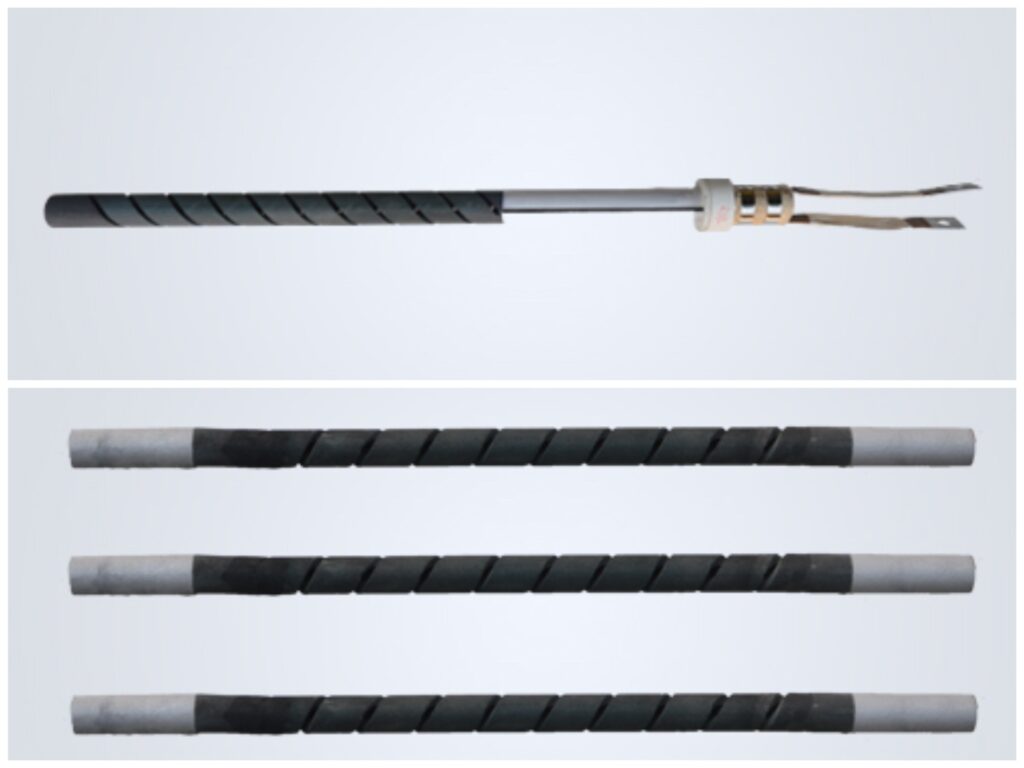
Single End Connection Design: The SCR double spiral SiC heating elements have electrical terminals at one end that pass through a single hole in the furnace wall for easy wiring.
Double End Connection Design: The SC single spiral SiC heating elements need terminal connections at both ends and thus need holes in the furnace wall at both ends.
Effect of Terminal Configuration of SiC Heating Elements: The optimal terminal configuration of SiC heating elements using single-end-connection SiC heating elements makes wiring from the rear unnecessary.
Hot Zone Design and Heat Distribution Density
Power Density and Thermal Uniformity within the Working Chamber are Defined by the Physical Slotting and Spiral Pitch of the Active Section.
Double Spiral Heat Concentration: The double-spiral slotting creates a longer, narrower current path, increasing electrical resistance per unit length.
Single Spiral Heat Radiant Profile: The single spiral silicon carbide heating rod has a single spiral pattern, which produces a uniform heat profile through the heating channels.
Slot Design of SiC Heating Element Hot Zone: The unique slot design of the SiC heating element hot zone eliminates localized hot spots, allowing for balanced surface load density (W/cm2) at 1450°C.
Performance Breakdown: SCR vs. SC SiC Heating Elements
A technical evaluation of electrical and thermal parameters enables engineers to match element characteristics with furnace power supplies and duty cycles.
Electrical Resistance and Voltage Regulation
Electrical properties determine transformer size, wiring choices for circuits, and phase balance in furnace system designs working at high temperatures.
SCR SiC Heater Elements – Resistance Comparison: The electrical resistance of SCR and SC elements depends on current-path length, cross-sectional area, and material resistivity.
Resistance Match: Through pre-delivery inspection, Songshan precisely matches the resistance values of SiC heating elements so that variation is within (± 5%). Hence, there is a balanced current.
Supply Voltage Compatibility: Due to their higher resistance property, SCR SiC heating elements can operate with increased voltage supply and lower circuit amperage.
Thermal Efficiency and Service Life Stability
Aging resistance, speed, and structural strength in operation depend continuously on material density, chemical purity, and surface treatments.
High Purity Recrystallization: Made from highly pure green silicon carbide (≥ 99% SiC) and recrystallized at over 2200°C, the components have excellent structural characteristics.
Silicon Carbide Heating Elements Longevity: The process of oxidation provides protection against oxidation by forming the SiO2 protective coating, and once element resistance doubles in comparison to its original resistance, replacement becomes necessary.
Surface Protection: Songshan coating silicon carbide heating elements are made with a special ceramic coating that prevents oxygen and water attacks on components, increasing their operational lifetime by 1.5-2 times.
Application Scenarios: Choosing the Right Heating Element
Matching spiral geometry to specific thermal processing equipment resolves spatial limitations and enhances process repeatability.
Compact and Space-Constrained Industrial Furnaces
A small-footprint thermal chamber needs specific configurations of the heater element that will provide maximum hot zone area and minimum mounting clearance.
Double Spiral SiC Heater for Small Footprint Chambers: For benchtop muffle furnaces, tube furnaces, and dental sintering ovens, the double spiral SiC heater for small footprint furnaces can be used for top-loading with only a single wall penetration.
Less Thermal Losses: Top-loading allows minimum penetration of the insulation, thus minimal heat losses from the furnace shell and lower energy usage.
Custom Spiral SiC Heater Elements: The spiral SiC heater elements with custom lengths of the hot zone (HZ) and cold end (CZ) can be supplied by Songshan.
Vertical and Horizontal Kiln Integration
Larger continuous kilns and controlled-atmosphere batch furnaces require certain element designs.
SC Single Spiral Application: The SC single spiral SiC heating elements are ideal for horizontal tube furnaces and continuous sintering kilns, as they can offer great support in the middle of the chamber and uniform surrounding radiation.
Flexibility of Atmospheres: SC and SCR elements have proven their reliability when used in oxidizing, neutral, and protected atmospheres due to surface load control.
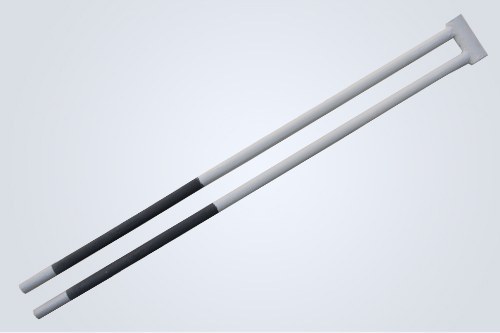
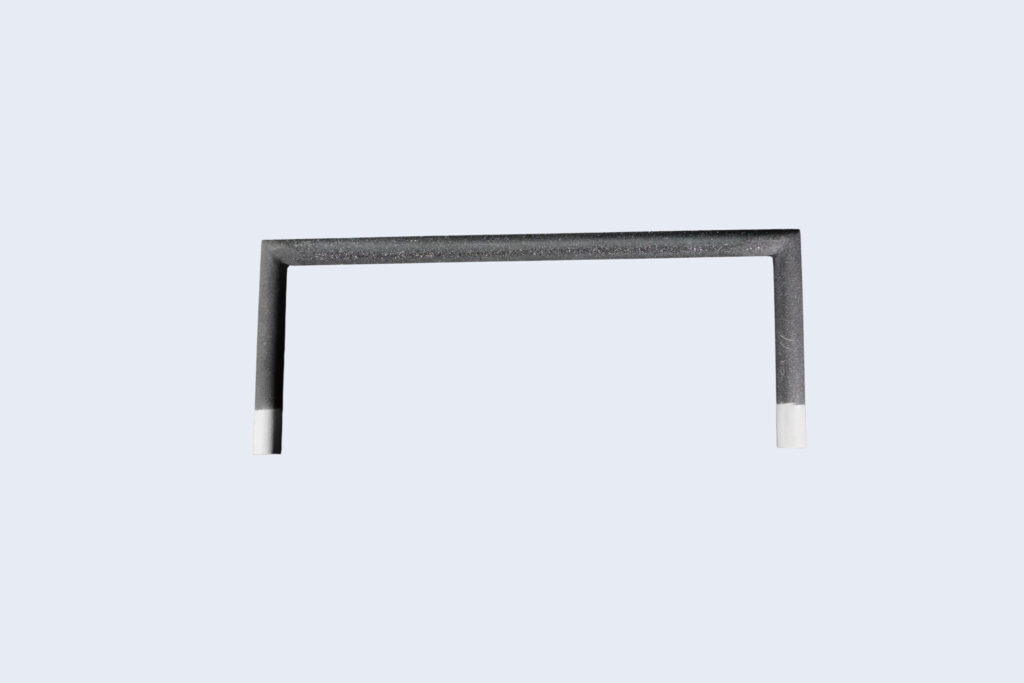
Complete Product Line: Songshan Silca ED (rod) type, DB dumbbell type, U type, and W type elements, along with Songshan Super MoSi2 heating elements, are offered to meet multi-zone kiln applications.
Concise Company Overview and Technical Services
Songshan combines decades of manufacturing heritage with comprehensive technical assistance to support global thermal processing industries.
Manufacturing Excellence and Global Support
Songshan delivers reliable high-temperature products backed by strict quality control and international engineering expertise.
Corporate Background: Founded in 1980, Songshan is a premier SCR SiC heating element manufacturer holding ISO9001 certification.
Global Footprint: Serving clients across 40+ countries, Songshan provides premium SiC elements, MoSi2 heating components, molybdenum and tungsten products, and refractory crucibles.
Professional Technical Services: Songshan offers furnace design evaluation, voltage regulation guidance, custom CAD drawings, and factory-matched resistance grouping to optimize heating efficiency and support custom spiral SiC heating elements.
Ready to optimize your furnace thermal performance and extend SiC heating element service life? Contact Songshan today at [email protected] or call +86-15639799780 to consult with our technical engineers, request custom element drawings, or receive a factory-direct quotation for high-performance SiC heating elements tailored to your specific application.
FAQ
Q: What is the structural distinction between SCR and SC heating elements made of SiC?
A: Double-spiral SCR heating elements made of SiC have two spiral grooves intertwined with each other, and both electrical contacts are located on one side of the element, while single-spiral SC heating elements made of SiC have just one spiral groove, but the electrical contacts are on different sides.
Q: How is single-side connection advantageous for compact furnaces?
A: It helps eliminate rear or bottom contact space and provides lower heat losses through insulating materials by having the possibility of feeding heating elements through just one opening.
Q: Why does the resistance matching up to (± 5%) matter in replacement of SiC heating elements?
A: It guarantees proper distribution of electric load on all the elements of the circuit without any overheating, temperature inconsistency, or early burnout of SiC heating elements.
Q: How could operators increase the service life of silicon carbide heating rods?
A: By operating heating units at the recommended surface load (W/cm2), adjusting SCR transformers to compensate for the resistance growing over time, using special coatings, and not exposing the elements to sudden temperature shifts.