

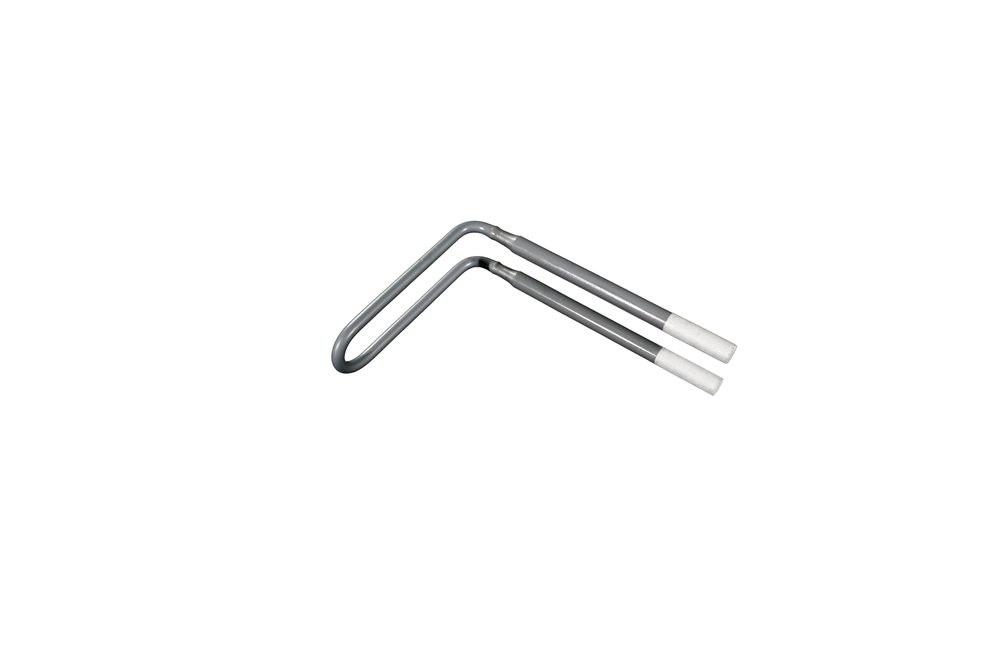
MoSi2 heating elements are often chosen for high-temperature furnaces when the process needs stable radiant heat and the chamber layout can support a brittle ceramic-like element correctly. L-shaped MoSi2 heating elements are especially useful when the hot zone and the connection area cannot sit on a simple vertical line, so the heater must follow an offset path while keeping the cold end serviceable.
The L shape is not a decorative variation. It is a layout solution for furnace openings, insulation thickness, support position, and terminal access. When those details are planned carefully, a molybdenum disilicide heater can support sintering, heat treatment, glass, metallurgy, and advanced ceramic processes without forcing the furnace designer into an awkward straight-element arrangement.
Many high-temperature furnaces are built around process access before heater access. Doors, hearth plates, shelves, setters, ports, and insulation can leave limited room for a straight element. L-shaped MoSi2 heating elements help when the hot zone needs to enter the heating space from one direction while the connection area must remain offset and reachable.
This shape can be useful in compact kilns, test furnaces, and specialized production chambers where the furnace shell does not allow a simple U or W layout. The selection still begins with the heating task. The designer must know where radiant heat is needed, how the load is arranged, and where the cold end can safely pass through the insulation.
The hot zone should face the load, not merely occupy the available space. If an L-shaped element places its hottest section too close to a wall, shelf, or product edge, the furnace may create a local hot spot while the center recovers slowly. If the hot zone is too far away, the process may need longer soak times or a higher element temperature to achieve the same result.
A good layout checks the usable heated length, the distance to the load, and the shadowing created by furniture inside the furnace. This is particularly important for structural ceramics, electronic ceramics, magnetic materials, and heat-treatment loads that respond to the full temperature curve rather than only the final setpoint.
The cold end must remain accessible enough for connection, inspection, and replacement. If the offset bend solves the chamber problem but hides the terminal behind insulation or metalwork, maintenance becomes slower and less reliable. L-shaped MoSi2 heating elements should therefore be selected with the service side of the furnace in mind.
Songshan dimensional references for MoSi2 products include hot-zone length, cold-end length, diameter combination, and spacing. Those details help translate a furnace drawing into a heater specification. For an L shaped MoSi2 heater, the bend is only one part of the decision; the entire path from terminal to hot zone must make sense.
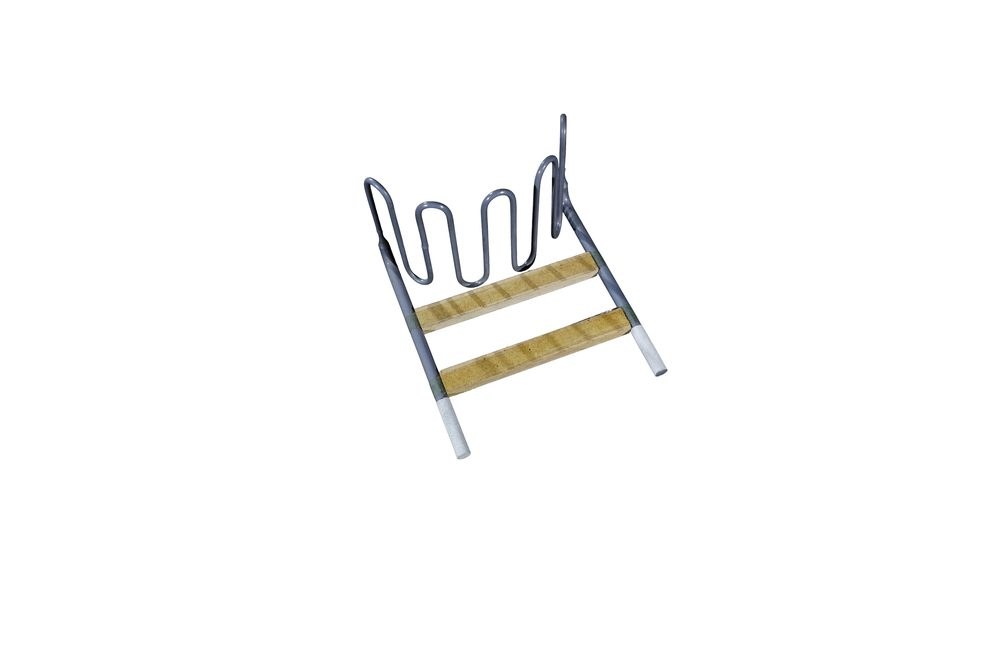
Molybdenum disilicide heating elements are valued because they can serve high-temperature furnaces and form a protective surface layer in oxidizing conditions. Songshan's MoSi2 product information identifies 1700 and 1800 grade series, with product pages describing use in demanding sintering and heat-treatment environments. Grade, shape, and furnace atmosphere should be reviewed together.
The material is also brittle at room temperature, so installation quality matters. An L-shaped element should not be twisted, forced into a misaligned opening, or loaded sideways by a poor support.
In an oxidizing atmosphere, a MoSi2 heater can form a compact quartz glass coating on its surface. That layer helps protect the inner material from continuous oxidation during high-temperature service. It does not make the element immune to poor furnace design, but it is one reason molybdenum disilicide heating elements are widely used where temperatures exceed the comfort zone of many metallic elements.
The protective behavior works best when the element is allowed to operate in a stable, suitable environment. Furnace atmosphere, temperature program, load chemistry, and air circulation can all influence service results. For offset layouts, the bend and connection area should not create a hidden cold or hot pocket that changes the element's surface condition.
MoSi2 heating elements are built for high-temperature work, but long operation around lower temperature ranges can create powdering risk. Songshan product information identifies roughly 400-700 C as a range where this issue may appear after extended use. For processes with slow ramping, frequent holds, or long idle periods, the temperature program deserves attention.
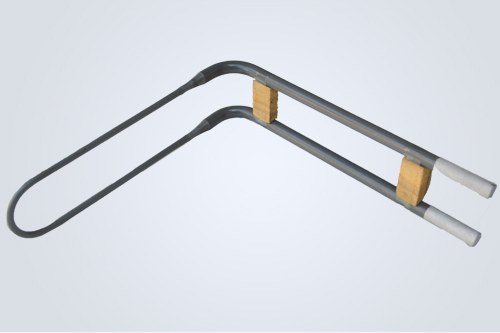
Shape selection should connect furnace geometry with process quality. U and W types can be effective for broad vertical coverage, straight or X forms may suit direct layouts, round or ring forms can fit circular heating paths, and L-shaped MoSi2 heating elements can solve offset entry conditions. None of these shapes is universally better; each answers a different chamber problem.
A U shape is often convenient when both terminals can remain on one side and the hot zone can hang vertically into the chamber. A W shape can broaden coverage where more radiant area is needed across a wider space. A straight form is simple when wall-to-wall installation and terminal access are both available.
The L shape becomes attractive when the furnace opening or support path is offset from the desired hot zone. It can help route the heater into the chamber without moving the connection into a high-temperature or inaccessible position. That makes it useful for retrofits as well as new furnaces with unusual internal geometry.
Songshan MoSi2 products include common diameter combinations such as 3/6, 4/9, 5/10, 6/12, 9/18, and 12/24 mm. These numbers should not be chosen only by habit. Diameter, hot-zone length, cold-end length, spacing, and grade affect the way the element fits, heats, and survives in a specific furnace.
For an offset layout, a small dimensional mistake can become a large installation problem. The bend may not align with the opening, the hot zone may sit too close to the load, or the terminal may be harder to connect than expected. A simple sketch with chamber dimensions, load position, support points, and terminal side can prevent many of these issues.
Songshan MoSi2 heating elements are most useful when buyers and furnace engineers treat shape as an engineering decision rather than a catalog shortcut. The brand's product range includes U, W, L, round, ring, and other forms, giving furnace teams room to match the element to the chamber instead of forcing the chamber around one shape.
For new furnace work, map the load first, decide where heat must enter, confirm where connection hardware can live, and then compare L, U, W, straight, round, or ring forms.
L-shaped MoSi2 heating elements help high-temperature furnaces solve offset layout problems without losing sight of heat coverage, cold-end access, material behavior, and service planning. Their value is strongest when furnace geometry, temperature program, atmosphere, and element dimensions are reviewed together. That combination turns a shaped heater into a stable part of the process rather than a fragile component placed wherever space remains.
Review Songshan L-shaped MoSi2 heating elements when an offset furnace layout needs a high-temperature heater with practical connection access.
A: L-shaped MoSi2 heating elements are useful when the desired hot zone and the available terminal position are offset. They can help route heat into a compact or unusual chamber while keeping the connection side accessible. The furnace drawing, load position, support points, and atmosphere should all be reviewed before selection.
A: In oxidizing atmospheres, molybdenum disilicide heating elements can form a compact quartz glass coating on the surface. This layer helps slow further oxidation during high-temperature service. The protection works best when the furnace atmosphere, temperature program, and installation layout are suitable for the material.
A: MoSi2 heating elements are described as having resistance that is largely independent of service time, so mixed use of new and old elements can be possible. The furnace should still be checked for matching shape, dimensions, support condition, terminal connection, and heating balance before returning to production.
A: The key dimensions include diameter combination, hot-zone length, cold-end length, spacing, bend layout, and total fit within the furnace opening. These details determine whether the element heats the correct area, avoids mechanical stress, and leaves the terminal side accessible for inspection and replacement.
© Henan Zhengzhou Songshan Enterprise Group Co., Ltd